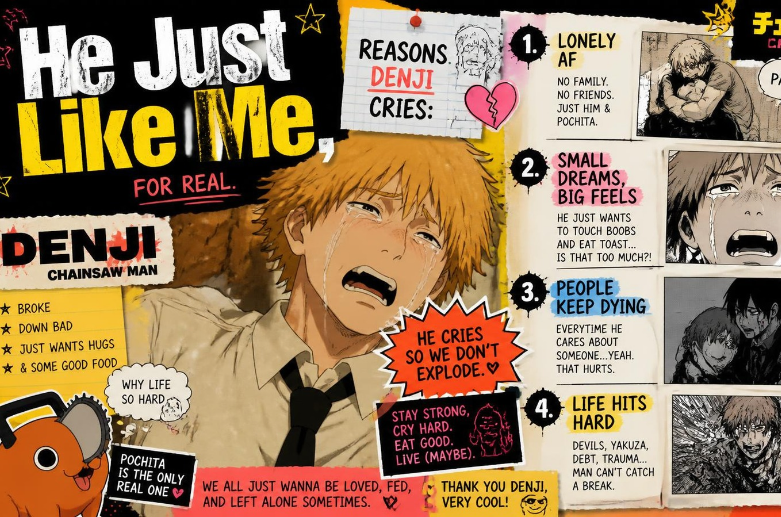
Seeing a fictional character make your exact bad decision can feel strangely personal. Internet users turned that feeling into one of the web’s most recognizable reaction memes. The phrase works because it can sound sincere and completely unserious at the same time.
Direct answer: “He just like me fr” means “he is just like me, for real.” People use it when a person or fictional character feels unusually relatable. The joke is often exaggerated or ironic, especially when the character has questionable habits, bad decisions, or an overdramatic personality the poster recognizes in themselves.
| Quick fact | Details |
|---|---|
| Meaning | “He is just like me, for real” |
| “fr” meaning | “For real” |
| Meme character | Denji from Chainsaw Man |
| Source image | An edited manga panel |
| Spread | Widely used online from 2021 onward |
| Common tone | Relatable, ironic, exaggerated, or self-deprecating |
| Related expression | “Literally me” |
| Common uses | Replies, captions, reaction images, memes, and comment sections |
What Does “He Just Like Me Fr” Mean?

The expression says that another person behaves, thinks, or struggles as you do. In ordinary English, it translates roughly to “he is exactly like me.” Adding “fr” makes the reaction sound stronger because the letters mean “for real.”
The phrase rarely needs a perfect resemblance between two people. A single habit, awkward moment, opinion, or bad choice can trigger the reaction. That small connection becomes funnier when the comparison is obviously exaggerated.
The phrase “He Just Like Me Fr” (where “fr” stands for “for real”) is a popular internet meme and slang expression used to express humorous, deep, or often self-deprecating identification with a fictional character, celebrity, or internet persona.
Where Did the Meme Come From?
The famous reaction image comes from Chainsaw Man, the manga created by Tatsuki Fujimoto. Its central character, Denji, appears emotional while looking at a television. The original scene did not contain the meme’s familiar caption.
According to Know Your Meme, the underlying panel appeared in chapter 93, released in November 2020. An edited version later replaced the original dialogue with a relatable reaction. The earliest documented online use of that recaptioned image dates to May 2021.
The image gained wider attention during 2021 and 2022. Users posted it across social platforms, forums, and fandom communities as a reaction. A voiced YouTube version also helped make the dramatic delivery more familiar online.
Why Denji Makes the Reaction So Funny
Denji already has an expressive personality, so the edited panel feels believable at first glance. He looks overwhelmed by what he sees on the television. That visual intensity makes an ordinary moment of recognition seem absurdly important.
The humor becomes stronger when people pair the reaction with a questionable character. A viewer may identify with procrastination, social awkwardness, laziness, or terrible decision-making. The post then becomes self-deprecating instead of genuinely flattering.
This style also connects with online jokes about identifying too strongly with fictional characters. LifeFie’s alternate reality explainer examines another way fiction invites people to imagine different versions of themselves. Both ideas turn fictional identity into something personally recognizable.
Is the Phrase Serious or Ironic?
It can be either, but irony is common. Someone may sincerely relate to a character’s loneliness, goals, humor, or experiences. The same wording can also mock an obviously ridiculous comparison.
Context usually tells you which reading makes sense. A wholesome post about a shy character may express genuine identification. A post comparing yourself with a chaotic villain probably carries more sarcasm.
The flexible tone explains why the expression works in many communities. Urban Dictionary entries describe it as recognizing behavior similar to your own. Other definitions also emphasize its sarcastic use when the comparison is intentionally overconfident.
How People Use the Meme Online
The reaction often appears beneath screenshots, movie scenes, anime clips, and social posts. People may post the image by itself because regular users already understand the implication. Others type the phrase without using the original Denji picture.
Common situations include:
- A character procrastinates instead of finishing an important task.
- Someone spends money immediately after promising to save.
- A movie character handles an awkward conversation badly.
- A gamer repeats the same mistake several times.
- A celebrity admits to an oddly specific habit.
- A fictional character becomes excited over a small success.
The best examples usually contain one recognizable trait rather than a complete personality match. That makes the joke easy for other people to understand. It also leaves enough exaggeration for the reaction to remain funny.
“He Just Like Me” vs. “Literally Me”
The two expressions overlap because both describe strong identification with somebody else. “Literally me” is broader and does not depend on one specific reaction image. It can describe a character, picture, behavior, mood, or entire personality type.
The Denji version feels more like a dramatic reaction. It often suggests that you have discovered someone who shares one of your embarrassing traits. That emotional presentation gives the meme its recognizable personality.
“Literally me” also became associated with discussions about viewers identifying with troubled movie characters. The Denji meme can make similar jokes without requiring that darker context. Both forms still depend heavily on exaggeration and self-awareness.
Readers who enjoy character-focused pop culture can also explore LifeFie’s Darth Vader without his mask. That guide looks at how a familiar fictional identity changes when viewers see the person beneath it. The connection is different, but both topics involve how audiences interpret recognizable characters.
What Does “fr” and “fr fr” Mean?
“Fr” is internet shorthand for “for real.” Writers use it to show agreement, sincerity, or emphasis in informal messages. It can appear alone or at the end of a sentence.
“Fr fr” repeats the abbreviation for extra emphasis. In standard English, that would roughly mean “for real, for real.” The repeated version can sound more dramatic or playful depending on context.
That means versions ending in “fr fr” do not change the central joke. They mainly intensify the reaction. The person is claiming an even stronger connection with whoever appears in the post.
How to Use the Phrase Naturally
Use the expression in casual spaces where slang fits the conversation. It works best in texts, group chats, social comments, fandom discussions, and meme posts. Formal writing or professional messages usually need clearer standard English.
You also do not need the original image every time. Typing the phrase beneath a relatable screenshot can communicate the same idea. People familiar with meme culture will often recognize the reference immediately.
For another example of LifeFie explaining recognizable entertainment characters, see its Kakamora guide from Moana. Pop-culture explainers like these give readers more context behind characters they may know mainly from images or short clips. That extra context can change how familiar internet references are understood.
Why the Meme Has Lasted
The reaction captures a common experience in only a few words. People constantly recognize parts of themselves in celebrities, friends, strangers, and fictional characters. Social media gives them an immediate way to share that moment.
Its self-deprecating quality also keeps it flexible. The comparison does not need to make the poster look impressive. Relating to someone’s mistakes can be funnier than identifying with their achievements.
The image also remains easy to remix. New movies, shows, games, and viral posts create fresh opportunities for the same reaction. The format survives because its meaning stays understandable even when the subject changes.
The Takeaway
The Denji reaction turned a simple feeling of recognition into a reusable internet joke. Its meaning is easy to understand even if you have never read Chainsaw Man. The humor comes from treating a small or embarrassing similarity like a life-changing discovery.
Use the phrase when another person or character feels suspiciously relatable. Keep the context casual, and let the exaggeration do most of the work. For more entertainment explainers, continue exploring LifeFie’s growing collection of pop-culture guides.
Frequently Asked Questions
What does “he just like me fr” mean in texting?
He just like me fr means that someone seems strongly relatable to the person writing it. The abbreviation “fr” stands for “for real.” In texting, the expression can be sincere, sarcastic, or playfully exaggerated.
Who is the character in the reaction meme?
The character is Denji, the protagonist of Chainsaw Man. The popular reaction comes from an edited manga panel rather than the original dialogue. Internet users recaptioned the scene before the image spread widely as a reaction.
Did the phrase originally appear in Chainsaw Man?
No, the famous wording was added by internet users. The original manga panel shows Denji reacting emotionally to a television for a different reason. The caption changed that scene into a joke about seeing yourself in somebody else.
Is the meme always sarcastic?
No, people sometimes use it sincerely when they connect with someone’s personality or experience. Still, exaggerated and ironic uses are extremely common. The surrounding post usually makes the intended tone clear.
What is the difference between “fr” and “fr fr”?
Both versions communicate “for real.” Repeating the abbreviation adds extra emphasis and can make the sentence more dramatic. It does not substantially change the meaning of the meme.