An alternate reality is a version of existence that differs from the world we know. It might feature another history, different choices, or entirely different rules. The concept appears across fiction, philosophy, games, and discussions about theoretical physics.
The idea becomes especially interesting when the imagined world closely resembles our own. One changed event could produce a different career, relationship, society, or history. That simple “what if?” question explains much of the concept’s lasting appeal.
Alternate Reality at a Glance
| Topic | Key Point |
|---|---|
| Basic meaning | A reality different from the familiar world |
| Common synonym | Alternative reality |
| Related concept | Parallel universe |
| Common uses | Fiction, games, philosophy, and speculative science |
| Scientific status | No direct evidence confirms accessible alternate worlds |
| Fictional purpose | Exploring different choices, histories, identities, and outcomes |
| Alternate history | Changes historical events while keeping recognizable connections to our world |
| Multiverse | A broader idea involving multiple universes |
Direct answer: An alternate reality is an imagined or hypothetical version of existence that differs from our familiar world. It may result from changed events, different choices, or different natural conditions. Stories often use these worlds to explore possibilities, while some physics interpretations discuss multiple universes as theoretical ideas.
What Does Alternate Reality Mean?
The phrase can mean different things depending on context. Cambridge Dictionary describes it as an imaginary world that differs from our known world in important ways. The term can also describe imaginary environments created for stories or games.
In science fiction, the idea often involves another version of Earth. Familiar people, places, or events may exist there but develop differently. A small change can sometimes become the foundation for an entirely different timeline.
Everyday speech uses the expression more loosely. Someone might use this phrase to describe an implausible belief or imagined situation. That conversational meaning shouldn’t be confused with scientific theories about multiple universes.
How an Alternate Reality Differs From a Parallel Universe
The terms often overlap, particularly in entertainment and casual conversation. A parallel universe usually means another universe that exists separately from our familiar one. An alternative world often suggests a recognizable version of our reality with meaningful changes.
Imagine two versions of the United States after one historical event develops differently. Those worlds fit the familiar alternate-world model because they share a recognizable starting point. A universe with completely different physical laws fits the broader parallel-universe concept more easily.
Neither distinction has a universally fixed meaning across fiction. Writers often use “parallel universe,” “alternative universe,” and similar expressions interchangeably. Context usually tells you what rules apply within a particular story.
Alternate Reality vs. Alternate History vs. Multiverse
These concepts sound similar, but they describe different storytelling or theoretical structures. Understanding their differences makes books, movies, games, and scientific discussions easier to follow. The table below compares them.
| Concept | Main Idea | Typical Example |
|---|---|---|
| Alternate reality | A different version of familiar existence | Your life followed another path |
| Alternate history | A historical event happened differently | A major war ended differently |
| Parallel universe | Another universe exists alongside ours | Another Earth exists elsewhere |
| Multiverse | Multiple universes exist within a larger system | Countless universes with different outcomes |
| Virtual reality | A computer-generated environment | Exploring a simulated digital world |
Alternate history stays closely tied to real historical events. Multiverse theories cover a much wider collection of possible universes. Virtual reality differs because people create its simulated environments using technology, and even virtual escape rooms show how immersive those made-up worlds can feel.
Where Does the Idea Come From?
Humans have imagined other worlds long before modern science fiction appeared. Myths, philosophical thought experiments, and speculative stories often consider worlds beyond ordinary experience. Modern fiction turned that curiosity into recognizable alternative timelines and parallel worlds.
Science fiction gave writers another useful question: What happens after one event changes? A different election, invention, discovery, or personal choice can reshape everything following it. Writers can then examine consequences without changing every familiar element.
Modern movies, television programs, comics, and games have made the concept even more familiar. Multiverse stories can place several versions of one character side by side. That structure makes abstract questions about identity unusually personal.
Why Are We Fascinated by Other Versions of Reality?
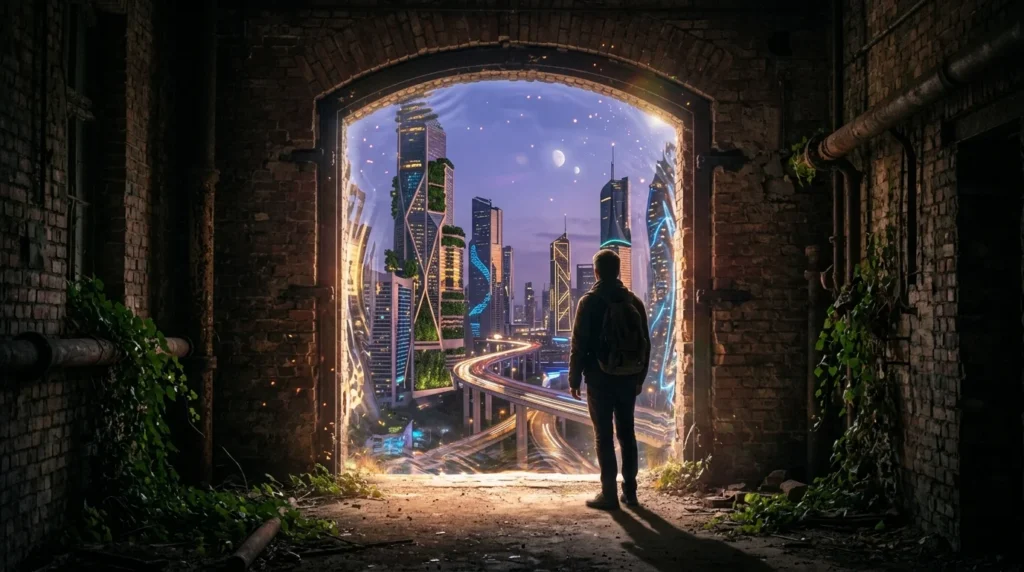
Alternative worlds turn ordinary choices into powerful thought experiments. Almost everyone can imagine a moment when another decision might have changed something important. Fiction transforms that familiar experience into an entire world.
These stories also let audiences examine real problems from a safer distance. A fictional society can explore technology, inequality, freedom, relationships, or social change without copying reality exactly. Readers can compare the imagined outcome with their own assumptions.
Many stories also raise a strong identity question. Would you remain the same person after different experiences and relationships? Another version of you provides a memorable way to examine that question.
Can Alternate Realities Exist According to Science?
Science currently provides no direct observational evidence that people can visit another version of reality. Ideas involving multiple universes appear in theoretical physics, but theories aren’t evidence of accessible worlds. Popular entertainment often blurs this distinction.
One frequently discussed idea is the many-worlds interpretation of quantum mechanics. It interprets quantum events as branching into multiple outcomes. That doesn’t mean scientists have discovered portals leading to other versions of Earth.
The multiverse also appears in several scientific and philosophical discussions. Different proposals use the term differently, so they shouldn’t be treated as a confirmed theory. Claims about traveling between these universes remain speculative, not established science.
Could There Be Another Version of You?
Fiction frequently imagines another person who shares your identity but lived through different events. That version might have another profession, family, personality, or set of values. The premise gives storytellers an immediate way to explore cause and effect.
Science cannot currently establish that another physical version of you exists somewhere. Multiverse discussions don’t provide evidence for a discoverable duplicate of every individual. Fiction takes theoretical possibilities much further because storytelling isn’t limited by experimental evidence.
Still, imagining another version of yourself can be a useful thought experiment. It can reveal which choices you consider important and which outcomes you value. The value comes from reflection, not from proving another version exists.
Alternate Realities in Fiction and Entertainment
Science fiction and fantasy regularly use alternative worlds because they create immediate possibilities. Writers can preserve recognizable characters while changing their circumstances. Audiences quickly understand the tension between the familiar and unfamiliar.
Alternate-history stories usually begin with a clear divergence from recorded history. Other stories create parallel Earths containing different versions of familiar characters. Games can go further by letting player choices determine which events occur, which is part of why people look for the most engaging games in the first place.
Alternate reality games use the term differently. These interactive experiences combine fictional narratives with real-world websites, messages, puzzles, locations, or other media. Players participate in the unfolding story instead of only watching it.
Are Dreams an Alternate Reality?
Dreams can feel like complete worlds while they are happening. Places may look familiar while people, events, and physical rules behave differently. That resemblance explains why people sometimes describe vivid dreams as other realities.
Calling a dream another universe differs from proving it literally exists elsewhere. Dream experiences occur without demonstrating travel into another physical world. The distinction matters when separating imaginative experiences from scientific claims.
Dreams can still inspire useful questions about possibility and identity. Writers use dreamlike worlds to explore choices ordinary life cannot reproduce. Their creative value doesn’t depend on proving those worlds physically exist.
What About Reality Shifting?
Reality shifting usually describes practices intended to experience a chosen or “desired” reality. Online communities sometimes describe those experiences as visiting fictional or alternative worlds. These claims should be separated from established scientific evidence.
No accepted scientific evidence shows consciousness physically moving between universes through such practices. Vivid imagination, focused attention, dreaming, and related experiences can still feel intensely convincing. A powerful subjective experience doesn’t automatically establish an external physical world.
That distinction allows people to discuss unusual experiences without dismissing how meaningful they can feel. Personal interpretation and scientific verification answer different questions. Evidence becomes essential when making claims about how the physical universe works.
Why the Idea Matters Beyond Science Fiction
Imagined worlds help us think about consequences. Changing one condition can reveal how strongly later events depend on earlier decisions. This makes alternative scenarios useful tools for storytelling and philosophical discussion.
They can also expose assumptions we usually overlook. A story might remove money, change family structures, or alter a familiar technology. Readers then notice how much everyday behavior depends on systems they usually accept.
The most interesting alternative worlds often tell us something about this one. Their differences make familiar values and choices easier to see. That makes the concept useful even without evidence that another universe physically exists.
Frequently Asked Questions About Alternate Reality
Is an alternate reality the same as a parallel universe?
The expressions often mean similar things in fiction, and writers may use them interchangeably. A parallel universe describes a separate universe existing alongside ours. An alternative world often implies a recognizable version of something that has changed.
Is there scientific proof of alternative realities?
No direct observational proof shows that humans can access alternative versions of reality. Some interpretations and cosmological models discuss multiple worlds or universes theoretically. Those ideas shouldn’t be presented as confirmed destinations that people can visit.
What is the difference between an alternate world and the multiverse?
An alternate world describes one different version or reality. A multiverse describes a larger collection containing multiple universes or realities. The exact definitions depend on whether the discussion involves fiction, philosophy, or physics.
Can choices create different realities?
Stories frequently use choices as branching points that create different timelines. Some interpretations of quantum mechanics involve branching outcomes, but everyday decisions haven’t been shown to create accessible universes. Fiction turns that uncertainty into a powerful narrative device.
Can humans travel to another reality?
No scientifically demonstrated method lets humans travel into another universe or timeline. Portals, reality-switching machines, and dimensional travel remain familiar science-fiction ideas. Future discoveries could change scientific understanding, but current evidence doesn’t establish such travel.
A Useful Way to Think About Other Realities
Alternative worlds sit at the intersection of imagination, storytelling, philosophy, and speculative science. Those fields ask different questions and require different standards of evidence. Keeping those boundaries clear makes the subject more interesting, not less mysterious.
The next time a story introduces another Earth, look for the point where things changed. Ask what stayed familiar and what developed differently afterward. That simple comparison reveals why imagined realities remain such powerful ways to explore our own.

