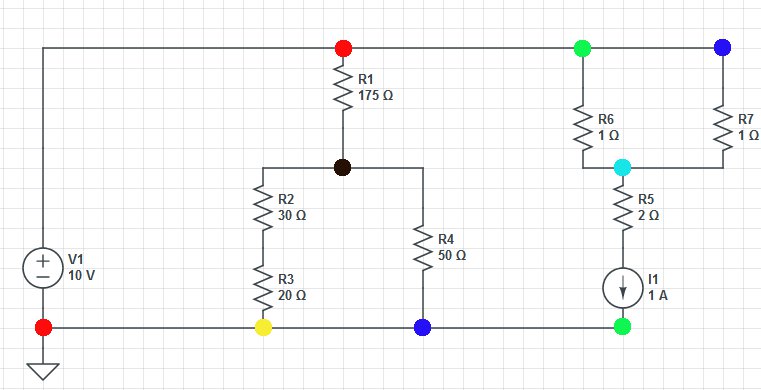
In electrical engineering, a node is any point in a circuit where two or more circuit elements connect. Unlike a single point, a node represents the entire segment of wire between connected components because, in ideal circuit diagrams, the connecting wires are considered to have zero resistance.
An electrical circuit is fundamentally built upon the concepts of nodes, branches, and loops. An electric network is defined as a collection of interconnected circuit components. This network may or may not provide a closed path for current flow. When one or more networks join to form a closed path, it becomes an electric circuit, allowing the steady flow of electricity. This means an electric circuit is created by connecting networks to establish one or more complete paths for current flow, based on node, branch, and loop principles. electrical device
What is an Electrical Node?
Electrical nodes are points in a circuit where two or more circuit elements connect, such as resistors, capacitors, or transistors. Each element has terminals—conductive ends that extend from the device body—used to connect to the circuit. A node is effectively the junction formed at the intersection of these terminals. The wires themselves between terminals form a node segment, assuming they have negligible resistance (zero voltage difference).
Definition of a Branch in an Electric Circuit
A branch is a path that connects two nodes within a circuit. Simply put, it is a two-terminal circuit element that forms part of the electric circuit. If the circuit element completes a path between two nodes, it allows current to flow through the branch, thereby creating a closed circuit path.
Branches connect nodes in an electric circuit and can either supply or absorb energy. In technical terms, a branch is any path between two nodes through which current can flow.
Read More: The Role of Citizen Developers in Low Code Application Development Platforms
Comprehensive Explanation of a Node in an Electric Circuit
A node forms where two or more branches or circuit components meet. It can be seen as the convergence point of multiple circuit elements like resistors, capacitors, and inductors. In other words, it is where two or more branches connect, acting as a critical junction in the circuit.
When Should Nodes Be Used?
Nodes play a crucial role when analyzing circuits with multiple current paths to conserve energy and simplify calculations. When applying Kirchhoff’s Current Law (KCL), using nodes is more convenient and reliable than relying solely on junctions. Breaking the circuit into smaller parts at nodes minimizes computational complexity, avoiding excessive equations and unknowns.
Essentially, nodes streamline the process of solving circuit currents and voltages and are fundamental to nodal analysis methods. That’s why KCL is often referred to as the “nodal rule.”
Mesh Analysis
Mesh analysis is a technique used for planar electric networks—those where branches do not cross over each other. Unlike nodal analysis that uses nodal voltages as variables, mesh analysis uses mesh currents.
This approach reduces the number of simultaneous equations needed to solve complex circuits and focuses on loops that enclose no other loops (“meshes”). Kirchhoff’s Voltage Law (KVL) is applied to each independent mesh to solve for unknown currents.
Do Nodes and Junctions Differ in Circuits?
The terms nodes and junctions often overlap and are used interchangeably as connection points between circuit components. In most contexts, asking about voltage difference between two nodes or junctions yields the same answer—commonly zero volts if in the same node.
However, engineers and scientists may emphasize the distinction depending on context, especially when precision is necessary. Understanding the specific use of these terms helps avoid confusion in detailed circuit analysis.
If you want to explore more about circuit fundamentals, visit our Tech category for detailed articles and tutorials. How Solar Inverters Impact Your Energy Efficiency
Frequently Asked Questions (FAQs)
A node is formed where two or more branches intersect. The total number of nodes in a circuit depends on the number of such intersections. In circuit diagrams, nodes are commonly represented by dots where components connect.
A node is a point where two or more terminals meet in a circuit, while a branch is the path or component connecting two nodes. In other words, nodes are connection points, and branches are the circuit elements located between these points.
A node is the junction of two or more branches. A branch is a single circuit element or path between two nodes. A loop is any closed path within a circuit where a current can circulate continuously without branching off.
Want to know about‘Replace Brake Rotors ‘Check out our ‘Tech ‘category.